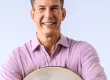
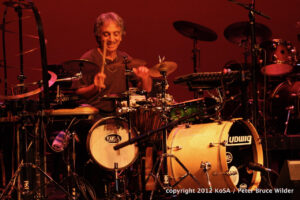
 Founder and Artistic Director of KoSA Communications, and the KoSA International Percussion Workshops and Festivals, Aldo Mazza is also a member of the world-renowned percussion ensemble, Répercussion. He earned a Bachelor of Music in Percussion, with a minor in Jazz Performance from McGill University, and attended graduate studies in Ethnomusicology at the Université de Montréal. In addition, Mr. Mazza participated in summer programs at Banff, Eastman School of Music, the Jamey Aebersold National Band Camp, and Drummers Collective.
His Performing experience is extensive: four world tours; numerous radio and television appearances; and performances for United States Presidents and Canadian Prime Ministers. As a recording artist Mr. Mazza has performed on over 100 recordings, and with such artists as: Celine Dion, Aldo Nova, James Brown, Chris DeBurgh, David Amran, Omar Sosa, and Alain Caron; with major symphony orchestras including the Montreal Symphony, SMCQ (Quebec Contemporary Music Organization); and at such events as: the Montreal Jazz Festival, and the Hong Kong Arts Festival.
Along with being a composer, record producer, publisher, and editor, he has been the subject of numerous publications including: McLeans, Percussive Notes, La Scena Musicale, the Montreal Gazette, and Modern Drummer Magazine. Moreover, Mr. Mazza has been the recipient of several Canada Council & Conseil Des Arts et Lettres du Québec Research grants.
When did you begin studying music?
At the age of 16 I began percussion lessons with a local teacher who studied with Saul Goodman.
What made you choose percussion?
I was a rock drummer, and I wanted to study classical percussion and learn from professionals who performed this genre of music.
Who were your primary teachers?
My first teacher was Neils Lund. I always played in rock bands throughout my high school years with the idea that I wanted to become a trained serious professional. From there I attended the University of Ottawa (Canada) where I studied one year with the great timpanist of the National Arts Centre Orchestra (NAC), Ian Bernard. Ian pushed me to audition for Pierre Beluse who was the percussion instructor at McGill and member of the Montreal Symphony. Ian insisted I do all that I could to attend McGill to study with Pierre Beluse. Pierre Beluse was a master percussionist (Canada’s Pierre Boulez).
While I was at McGill, I attended at least one or two summer classical percussion camps, marimba camps, and jazz camps including the Jamey Aebersold annual camps. I also went to every clinic I could on any instrument, and even attended a masterclass with John Cage.
I also travelled to New York monthly to study with as many top artists as I could. These included lessons with Bernard Purdie, Narada Michael Walden, Gene Golden, Sam Ulano, David Samuels, Frankie Malabe, and many others. During those years, I spent a lot of time in New York and met drummers: Steve Gadd and Allan Shwartsberg, who invited me to their recording sessions to watch and meet other musicians.
When did you decide to pursue a career in music?
I did not actually decide, but I would dream about it, and took every opportunity to study, play, and participate in anything I could which I thought would help me on my journey. I was focused and followed all the advice I could. One thing always led to another and I just kept at it.
Did you have a specific goal?
My goal was to work hard and learn as much as I could so I could be a studio musician in New York and then Los Angeles. During this time I was becoming extremely busy in Montreal: recording, live concerts with well-known artists, television shows, jingles, etc. I was fortunate to work with many great artists at that time: Celine Dion, James Brown, classical recordings, National Film Board, CBC as well as meeting the other members of my group, Repercussion. This percussion quartet exploded on the national scene and toured the world many times. We collaborated with major symphony orchestras, choirs, jazz artists such as Claude Bolling, and recorded six commercial CDs. We were performing over 150 concerts annually and we are still active, though only for special projects now. I was also fortunate to record over 100 albums with a variety of artists and styles, a number of film soundtracks, produced and composed music for albums and percussion ensemble. Because I was in such demand in Montreal, my original plan to move to New York and Los Angeles became highly improbable.
Do you focus on a specific area of percussion?
I do not focus on a specific area of percussion. To me they are all related. I have always been fascinated by all music, all percussion, and all the various cultural languages. Music is the universal language that grants all of us the ability to understand and interact with each other without uttering a word. We are so fortunate to have this language of music which allows us to have a common ground.
Who impacted your musical growth the most?
My main musical mentor was Pierre Beluse in Montreal, but there were also many others that I studied with and learned from. I also had mentors outside the musical community who understood the connection between ourselves, and the world, so we can bring ourselves to a level where we can contribute to the success of each other to make the world a better place.
I have always found it odd that some in the arts community, and outside it, do not understand the importance of creating continuity, bringing something to the table, and/or being an instrument of change and betterment. Some business people, and even artists, gloat at the fact that they made millions, but the question they do not answer is how have they been helpful to others.
What teaching positions have you held?
I was an Adjunct Professor at McGill University in Montreal, and at Castleton University in Vermont. I am also the Director of KoSA Academy and KoSA Institute, and I am responsible for our educational programs and collaborations around the world. Through the KoSA Academy, we have established an international institute whereby I have taught many individuals all over the world. These classes also offer transferable university credits to those who attend.
What percussionists have inspired you the most?
Ian Bernard, Pierre Beluse, Steve Gadd, Arnie Lang, John Cage, and countless others who I have come in contact with. I am a sponge and still learning from others who have spent time researching, exploring, and offering insights into their worlds.
Is there a specific genre you enjoy performing the most?
I do not have a specific genre that I focus on, but rather choose from classical, jazz, and world cultures that have meaning for me aesthetically. I really enjoy the art of improvisation and am involved in promoting and teaching it. Even though classical music is a lost art, I still offer workshops and perform it as well as jazz, pop, and world music.
What composers do you identify with?
I am a big fan of Debussy, Beethoven, Ravel, The Beatles, Dave Brubeck, and Pat Matheney. These composers always pushed the creative envelope, and spent their lives thinking outside the box in search of beauty, new ideas, and sounds.
Do you get nervous before you play?
Yes, I still get nervous minutes before performing. However, it is not the same nervousness as I had as a student. It is more of a nervousness of the unknown. To deal with it, I learned long ago as a university student the art of Transcendental Meditation. It has been my personal saviour all my life since then. I also came to the realization that the best way to deal with nervousness is firstly to over prepare. Secondly, learn the art of instant improvisation to deal with any possible curveball. Lastly, I learned that minutes before I perform, my mind needs to go to a special place. To achieve this, I need absolute quiet so I can transform my thoughts to become a musician who has a heightened sensitivity and mindfulness, so that I may communicate the language of music to, and with others.
Do you ever make a mistake while performing?
Yes I make mistakes, or get sidetracked by something around me. My way of resolving any errors is accepting what happened as another interpretation, and go with it musically.
Has your practice regimen changed from when you were a student?
When I was a student, I would practice seven to eight hours a day because I started my musical training late, and was making up for lost time. Also, I was in a huge environment of friendly competition, and we all knew this was the greatest chance we had to be accepted in the community. I was also fortunate to have met my band mates of Repercussion, who had insane work ethics to be the best.
When Repercussion exploded on the national scene, our agent booked us all over the world, requiring us to often prepare multiple programs. It was great because it gave me the opportunity to constantly keep up my technique on all percussion instruments. Now, I still study, and practice each day on most of the instruments to keep my technique fresh and in shape.
How do you define a good musician and a good teacher?
For me, good musicians are those who have spent enough time not only on their instrument, but have listened to enough music of all kinds to understand the laws of musical structure; the natural laws of human emotion; have built a sensitivity to the concepts of tension and release; and listen well when having a musical conversation.
Good teachers are those who have over their lifetime taken the time to analyse technique and how it works for each individual. A good teacher has spent a lot of time understanding and building an ability to communicate ideas or concepts; one who is constantly seeking more knowledge to impart onto others; and one who has patience, good listening skills, and a genuine interest in the well-being of others.
Do you think that performing and teaching are intrinsically intertwined?
I truly believe that teaching and performing are intrinsically intertwined. We are constantly teaching ourselves something and then we are able to share our insights better to students and persons we mentor. One side always confirms the other or puts some aspects in question for further thought.
Has teaching made you a better musician?
I love teaching as much as performing. When performing we take the time to understand the music and the technique needed to perform it. When we teach, we communicate our results, findings, or discoveries from where we are standing. While communicating this to a student, we are also continuing to teach ourselves and solidify our ideas and personal discoveries.
What is KoSA and how did it come about?
KoSA was a vision I had for years before I was able to launch it. The name comes from the Italian word la cosa (I purposely changed it to KoSA), which means The Ultimate, The Thing, or this is It. My vision was to create a one week workshop/camp where participants would come from all over the world to study with top artists in a small, personal, and intense environment. I had the good fortune to have worked with so many great artists that I was able to call upon, such as: Neil Peart, Jimmy Cobb, Joe Morello, Mike Mainieri, Leigh Stevens, Steve Gadd, and Arnie Lang to be on our faculty. This has resulted in an atmosphere where faculty and students eat, perform, and study together, creating an ideal educational and artistic experience.
What inspired you to create your podcast: Shaping Your Journey?
This project was also an idea I had been wanting to start, and because of the Covid lockdown, I was finally able to do so. I felt it was time now in my own journey to have long informal conversations with those in the music business who would share their experiences that led them to do the great work they accomplished. It was important for me to have them share their thought process, and why they made certain decisions that ultimately shaped their journeys. This was important as it would provide for a bank of inspirational and informative materials for viewers to be inspired by, but also provide an archive of conversations with very impactful individuals who are leaving important legacies.
Knowing what you know today, would you change how you prepared for your career?
This is a good question and I personally would not change anything. I always took the opportunities presented and worked hard. We are masters of our destiny and every decision is the right one. Curiosity is important. I was fortunate to always have been curious which led me to always move forward in my journey. I do not believe in coincidence.
What words of wisdom would you share with students?
I strongly believe that everything is possible and those who are serious need to set their sights on what they envision, big or small. If the environment that you want is not around you, then go to where there are people like you. Attend seminars, clinics, camps, travel anywhere you will meet like-minded people. Work on your craft. Have fun with it. Step out of your comfort zone. Build your knowledge base, and seek mentors who will be part of your network and success.
Learn how to be organized, professional, and how the music business works in all its forms. Meditate so you can keep a good mental balance, and be a helpful person in your personal and professional life. The words, How can I help? Should be part of our mantra.
Music is an extraordinary gift we have and it is a universal one. As things change, more opportunity is created. I suggest to everyone to focus on what part of the music world makes you the most happy. Be as self-sufficient as possible, and create a place to showcase your invaluable capacities. Lastly, remember that each one of us is unique, and there is room for all.
If you would like to learn more about Mr. Mazza, please visit his website: www.kosamusic.com