
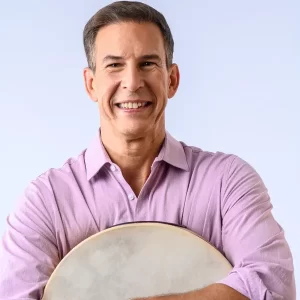
 Director of the Percussion Departments at Vassar College and the Brooklyn College Conservatory of Music, Frank Cassara is also the Principal Percussionist with the Riverside Symphony. A proponent of classic, modern, and world music, Mr. Cassara has premiered many works with diverse groups, and regularly performs with the Philip Glass Ensemble, Percussia, Music From China, and the North/South Consonance. Moreover, he has performed with Steve Reich and Musicians, the PULSE Percussion Ensemble, and the Newband/Harry Partch Ensemble.
As a free-lance percussionist, Mr. Cassara has subbed for numerous Broadway shows and can be heard on many recordings and film scores. Moreover, he has released two CDs: Apparition, featuring his compositions for jazz quartet; and Pathways, which are his arrangements for vibraphone and piano of the music of Steve Reich, Phillip Glass, and John Adams.
When did you begin studying music?
I began private instruction on the drums around the second grade.
What made you choose percussion?
My father was an amateur guitarist so he thought I could learn to play the drums and accompany him. The program at my elementary school started in the fourth grade, however I wanted to play the trumpet. Luckily, they had too many kids trying out for trumpet, and once they discovered I was taking drum lessons outside of school, they let me in the program as a drummer. I continued in the public school music program as well as privately, and advanced into all of the ensembles: band, orchestra, and jazz band. In high school I was a member of a few rock bands, as many drummers were at that time.
When did you decide to pursue a career in music?
In high school I had actually taken many advanced placement courses in science, because I thought I was going to go into chemistry or biology. During my senior year of high school, my band teacher, who was also a great jazz performer, convinced me that I could actually make music my career. I auditioned for a few schools and was accepted into the Manhattan School of Music (MSM). There I studied with James Preiss, and I also studied drum set privately with Charles Perry.
Did you have a specific goal?
After graduating MSM, I tried to make a living playing drums mostly, but it wasn’t quite working out. So two years later I ended up back at MSM with James Preiss. I was also greatly influenced by Claire Heldrich who ran the percussion and contemporary ensembles at MSM. I became very accomplished on mallets and realized this was the path I was going to take, especially contemporary music.
Do you focus on a specific area of percussion?
Originally I had planned on being a drummer, as my father was an amateur jazz guitarist. This wasn’t quite working for me, so when I returned to MSM, I concentrated on my overall percussion and mallet skills. Because Mr. Preiss was a great marimba player, this influenced me to pursue mallets more than anything. I also enjoyed the challenge of playing mallets on complex contemporary pieces by such composers as Wourinen, Carter, and Martino. To carry that further, meeting Valerie Naranjo in the Philip Glass Ensemble influenced me to open up a whole new avenue of playing the African gyil.
Who impacted your musical growth the most?
I would say that James Preiss had the most profound influence on my musical growth. He was an excellent performer and teacher, and our personalities gelled just right. He was the one that introduced me to Steve Reich who I would later play with. Claire Heldrich was another person who ingrained a superior work ethic in my playing and observation of music. I had been in her contemporary ensemble at MSM and continued to play in her professional group, The New Music Consort afterwards. I also have to add my drum set teacher outside of school, Charles Perry, who pushed my skills by incorporating new techniques.
What teaching positions have you held?
My first position was right out of grad school at Long Island University’s C.W. Post campus, where I was for about 40 years. I am presently teaching at Vassar College, and at the Brooklyn College Conservatory of Music.
What percussionists have inspired you the most?
This is a tough question because I am influenced by any percussionist who puts him/herself forward and plays to the highest level with the most heart. For instance, I often play with Barry Centanni, and he doesn’t realize that I study the way he plays because I find him so good. I’m drawn to people who expand their bounds, such as: Valerie Naranjo or Glen Velez (even though I don’t play hand drums well). As well as Bernard Woma and Kakraba Lobi who were such a joy and inspiration to study the gyil from and to learn the culture behind it. I could make a huge list.
Is there a specific genre you enjoy performing most?
I would say that I am attracted to contemporary music more than standard orchestral repertoire. But when I refer to contemporary music, I don’t necessarily mean atonal or avant-garde. I enjoy the aspect of performing new works and the challenge of interpreting and performing problematic passages. I still dabble in jazz and even released an album; but I consider myself an amateur in that respect.
What composers do you identify with?
I really love the music of Steve Reich. His intense rhythms are so interesting, and his harmonies are just hypnotic. I think the combination of classical and jazz studies has helped me to appreciate and perform his pieces in a way that is personal to me. Philip Glass’ music affects me in a different way. I find his simpler melodies and harmonic structures so moving. Maybe it’s because I played in both of their groups that I find an inner sense of their music.
Do you get nervous before you play?
When I was younger I used to get very nervous. I would use breathing techniques to calm down and have my mind focus on the music and not the audience. As a young player, I was very worried about what people thought of me and my playing. It also depended on what I was performing. In an ensemble you just blend in, but playing a solo, it’s all you. Nowadays, I don’t have that problem. Many, many years of experience has taught me to play for myself and enjoy the music, and hopefully everyone else will too.
Do you ever make a mistake while performing?
I do make mistakes while performing. It’s part of being human and I don’t let little flubs bother me. Half the time it goes by so fast the audience doesn’t recognize it. The objective is to keep moving forward; forget about where you were and think of what’s ahead. It’s more important to focus on the interpretation and presentation of the WHOLE piece rather than worry about mistakes here and there.
Has your practice regimen changed from when you were a student?
It has definitely changed from when I was a student. When I was in school, and times after, I focused on perfecting my technique because I had the time to do it. As you get older and life hits you with many things, I now have to be more concise with my practice regimen in order to accomplish my goals at an efficient rate. As I play a lot of contemporary music, many of the parts are studies unto themselves, so practicing this music is still advancing my technique. At this point I don’t have time to practice all of the primary instruments religiously, so I will work on them as needed depending on what I am scheduled to perform.
How do you define a good musician and a good teacher?
Being a good musician and a good teacher are not mutually exclusive, however, I have seen some circumstances where a great player is not necessarily a good teacher and vice versa. We all know great performers: those who really know the music they are presenting, and have refined their technique so well that they render the piece as a moving and expressive piece of art. The trick to being a good teacher is having the knowledge to be able to convey that technique, expression and even motivation in a way that the student can understand and absorb. Teaching also requires a certain openness so that one can connect with a student on a personal level. Otherwise, students can just watch Youtube videos.
Do you think that performing and teaching are intrinsically intertwined?
I’ve noticed for myself that when I am teaching a technique, a musical concept, or just a broad percussion question, I have to look into myself to develop the answer. I analyze myself to determine what and why I am doing something a certain way. This causes me to reflect on my own playing choices, and solidifies my own musicianship.
What usually motivates you to compose?
I don’t have a particular motivation. Sometimes I will write for a particular occasion, such as a recital or dance performance. Other times I just have ideas in my head that I like to put down on paper and develop it from there. These ideas I will revisit every so often until I decide to really work on the piece for a concert. I find enjoyment in composing for no particular reason, and it can be a great musical exercise for my brain.
How do you feel when someone performs your work differently than you intended?
I’m always happy if someone wants to play my pieces, and if the performer has another interpretation, I am very open to hearing it. I am not in any way a schooled composer, so I take different ideas from the player seriously, as long as my original intentions are not impeded.
Knowing what you know today, would you change how you prepared for your career?
That is a hard question to answer because things are quite different from when I was in school. But I don’t believe I would change anything. When I was a student, I learned to be an all around percussionist. I could play a marimba solo, play in an orchestra, or play the drum set in a wedding band. Today there seems to be a move toward specializing in a particular area of percussion. Since I didn’t really concentrate on any specific genre or instrument, my trajectory was somewhat scattered because of my musical interests. Looking back on it now, maybe I could have refined this aspect of my studies.
What words of wisdom would you like to share with students?
It is a long road to develop a career in music. There are so many great players and not enough work for all of them. I would say that you have to get yourself noticed; stay friends with colleagues; get to know other players; and reach out to contractors. I think it is important to have a side project going on to keep you performing: like presenting library concerts, or other public performances that can help your musical resume. Teaming up with other players is helpful in that it becomes another contact. If your heart’s in it, and you can stand the ups and downs, it is quite a remarkable career that not a lot of people get the freedom to choose.
If you would like to learn more about Mr. Cassara, please visit his website at: https://frankcassara.com/


