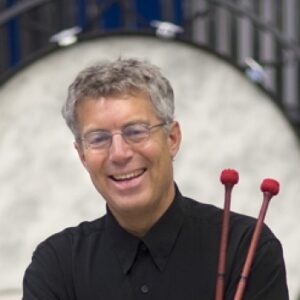
 Jonathan Haas is a Professor of Music, Director of Percussion Studies, Co-Director of the orchestra program, and conductor of the Contemporary Music Ensemble at New York University. He also teaches at the Juilliard Pre-College (JPC) Division, conducts the JPC Percussion Ensemble, as well as the Aspen Music Festival Percussion Ensemble. Mr. Haas is Principal Percussionist of the American Symphony, Principal Timpanist of the New York Pops Orchestra at Carnegie Hall, Principal Timpanist of the Aspen Chamber Symphony, and a percussionist with the American Composers Orchestra. He has garnered international acclaim for his performances of Philip Glass’s Concerto Fantasy for Two Timpanists and Orchestra, which he commissioned and has performed seventy times worldwide with numerous top orchestras.
Mr. Haas has performed and recorded with Emerson Lake and Palmer, Aerosmith, Black Sabbath, The Who, the Grammy Award winning Zappa’s Universe, and many others. In his quest to showcase the timpani in unusual musical settings, he is known for his Hot Jazz Timpani performances, highlighting an unusual instrumental combination with his nine-piece Latin/jazz ensemble, Johnny H. and The Prisoners of Swing. He is the author of a ground breaking timpani method book, Jazz Virtuostics for Timpani distributed by Bachovich publications, and is President of Gemini Music Productions, the largest employer of musicians in New York.
When did you begin studying music?
I began my study of music and percussion at New Trier High School in Winnetka, Illinois studying with the legendary Chicago drumset artist and teacher, Jake Jerger. I attended Washington University in St. Louis as a liberal arts student and decided to get serious about becoming a musician in my junior year, studying with Richard Holmes, Richard O’Donnell, Tom Stubbs and John Kasica, all who were members of the St. Louis Symphony at that time.
Did you always study percussion?
I began studying drums at age 8 with Rick Bottel, a Chicago freelance percussionist and teacher. Although at that age I was unable to predict this would be my instrument of choice, I did know it was equally as much fun as ice skating and baseball practice. I attempted to take up the trumpet with poor results because I had braces on my teeth and blowing into the mouthpiece gave me a headache. On the other hand, I could practice drums in my basement for hours on end with no adverse results, other than my family wanting to move out of the house.
What made you choose percussion?
I went to a concert in my early teenage years at the Ravina Festival and heard the first concert tour performance of Frank Zappa’s Mothers of Invention. Ansley Dunbar was running up and down the concert venue aisle playing on top of the wooden audience chairs, and it was at that moment I said to myself, This is the life I want to live!!
Who were your primary teachers?
Saul Goodman, Buster Bailey, Charles Owen, Richard Holmes, Richard O’Donnell, John Kasica, Tom Stubbs, Barry Jekowsky, Bajan Sopori (tabla), Jake Jerger, and all of my students who I have taught over the last four decades!!!
When did you decide to pursue a career in music?
I decided to become a serious music student my junior year in college, and committed to a professional career after my graduation from the Juilliard School in 1979.
Did you have a specific goal?
My goal has always been to explore and share the many unusual areas of music that are both provocative, inspiring, and bring interest and happiness into people’s lives.
Do you focus on a specific area of percussion?
My first love is timpani. As a teacher and professional musician I have always strived to excel and maintain the highest standards of performance and pedagogy on all percussion instruments. I wish I had enough time to learn ALL percussion instruments, unfortunately I don’t. But I try my best to learn new instruments and approaches to playing them whenever possible.
Who impacted your musical growth the most?
I consider myself somewhat old-fashion in that my student years were the most formidable which included emulating and at times, copying/imitating my teachers.
What teaching positions have you held?
I have been a teacher/artist at the Aspen Music Festival for four decades; and at New York University and the Juilliard School for 20 years. I have also taught at the City University of New York Graduate Center, the Hart School of Music, Peabody Conservatory, and masterclasses in China, Europe, South America, Israel, and Southeast Asia.
What percussionists have inspired you the most?
Billy Cobham was one of the first percussionists who inspired me in becoming a musician. He was playing with Mahavishnu Orchestra, and his playing was beyond thrilling.
Is there a specific genre you enjoy performing the most?
I would have to say Rock and Hip Hop
What composers do you identify with?
Frank Zappa, master of the music composition universe; Philip Glass, one of my favorite minimalist composers; David Byrne for his composition The Forest and his band Talking Heads; and of course, Bach!!!
Do you get nervous before you play?
I don’t know anyone who doesn’t get nervous when they perform!!! My prescription to minimize this human response (getting nervous) is as follows:
- Practice and prepare as thoroughly as possible. It is the unknown, or underprepared portions of what we perform that are the culprit in regard to feeling nervous.
- Stay busy with several other projects/preparations concurrently while preparing a big performance to help spread the overall pressure of finding excellence combined with the process of exploration and preparation. Preparation supports successful performance and performance relies on thorough preparation.
- Rest and nourishment always support a meaningful and positive experience in whatever we do: it helps to minimize that uncomfortable feeling that often accompanies being nervous.
- Adrenaline naturally secreted by our bodies, triggered by the brain, is important to understand as an organic way in which our mind/body deals with tension, anxiety, nervousness, success, excitement etc. It is 100% OK to get nervous. We are all human beings as this is a part of our DNA!!
Do you ever make a mistake while performing?
Anyone who says, I never make a mistake when performing, I would like to meet, and I assume I will never meet such a person. We all make mistakes. My strategy for minimizing mistakes is during the rehearsal process, my individual part becomes completely studied and marked up with cues, tempo indications, and anything that is additional information that I need to remember. But if I make a mistake during a performance, I reflect upon the reason it occurred and take immediate action to rectify the issue. It could be as simple as making an additional indication in my part that I did not previously note, or it can be as involved as going back to the score to have a better understanding of what is taking place.
Has your practice regimen changed from when you were a student?
When you are done with school, the greatest hurdle for many students going into their professional lives, is the need for somewhere to practice and instruments to practice upon. The second hurdle is time to practice once your professional and personal life comes into focus, thus dictating what your day is going to look like and hold. Simply put, post-school you become much better at practicing more effectively and economically because you usually have a lot less time to practice. My primary goals and strategies for practicing are as follows: it needs to be constructive, informative, fun, and highly organized.
How do you define a good musician and a good teacher?
A good musician is a good teacher and a good teacher is a good musician. A musician who is willing to learn will advance their goals and aspirations. A teacher who is willing to learn will remain relevant, effective, and be a beacon. In the olden days of percussion education, information was imparted in a very specific and experiential manner: Watch me do it, now YOU do it! It worked well for myself, but as my many years of teaching experience increased, so did the need to explain and offer reasons to why in lieu of, Because I told you that is how to do it.
Do you think that performing and teaching are intrinsically intertwined?
My pathway into teaching was through performing. All of the great teachers that I have worked with became such the same way. It seems to me that being a practicing performer is the road to being a great teacher.
Has teaching made you a better musician?
A teacher needs to stay in front of the ever increasing and ever changing information that continues to advance and develop. Teaching has been my primary motivation in seeking new ways, new approaches, and new views of how to develop into an outstanding musician and citizen of the world.
Knowing what you know today, would you change how you prepared for your career?
My plan, if I return in an after-life, is to learn to play all of the instruments I never had the time to learn, and I would start with tabla.
What words of wisdom would you like to share with students?
If you love what you do, you will be doing what you love to do. I’ve been banging on drums for close to five decades and can think of nothing more fun, valuable, or fulfilling than doing this!!!