Director of Percussion at South Dakota State University (SDSU), Dr. Aaron Ragsdale teaches applied percussion, percussion pedagogy, conducts the SDSU Percussion Ensemble, and serves as Assistant Director of the renowned Pride of the Dakotas Marching Band. He earned a Bachelor’s Degree in Music Education from the University of Oklahoma; a Master of Music from the University of Arkansas; a Doctor of Musical Arts from Rutgers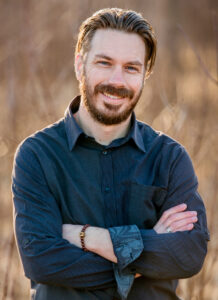 University; and he studied under the tutelage of She-e Wu, Bob Becker, Alan Abel, Richard Gipson, and Chalon Ragsdale.
In 2016, Dr. Ragsdale was named Outstanding Artist in the SDSU College of Arts and Sciences for his work as the composer-in-residence for the Harvey Dunn Collaborative. Moreover, from 2016 – 2018, he served as the Patricia Noethe-Pierce Artist-In-Residence at South Dakota State, commissioning a slate of new solos and duets that were performed at Symphony Space in New York City.
An advocate and activist in the realm of new music, Dr. Ragsdale has premiered and commissioned over 20 works for percussion by such composers as: Adam Silverman, Steven Snowden, Roshanne Etezady, Nick Zammuto, Katherine Bergman, Jay Batzner, Dave Hall, Gene Koshinski, Alicia Jane Turner, Kimberly Osberg, Emma O’Halloran, Ivan Trevino, and David Skidmore. In addition, his percussion quartet, Opener for R.H., which he composed with Barrett Hipes, is published by Studio 4 Music, and has been performed by ensembles around the United States.
Along with being a member of the South Dakota Symphony Orchestra, Dr. Ragsdale has maintained an active career as a solo and chamber musician. He has appeared at the Percussive Arts Society International Convention, the National Conference on Percussion Pedagogy, and the National Association of College Wind and Percussion Instructors. He has also performed at Days of Percussion in Arkansas, Oklahoma, and South Dakota; and as a marimba soloist with the Rutgers University Percussion Ensemble as part of the Great Music at St. Bart’s concert series at St. Bartholomew’s Church in New York City, as well as with the South Dakota State Wind Symphony during their performance at the Percy Grainger Wind Band Festival at Symphony Hall in Chicago, Illinois. Dr. Ragsdale can be heard on the recordings: A Miraculous Tale: Mixed Music for Percussion and Saxophone, with saxophonist Nathan Jorgensen, which is on the Centaur label; and on Resonance, with flutist Tammy Yonce which was recorded at the Tank Center for Sonic Arts in Rangely, Colorado, and is available on the Bandcamp platform.
When did you begin studying music?
I started studying piano when I was in kindergarten. It was a stereotypical piano lesson: 30 minutes a week with Ms. Giles (and her cat). We did all the piano guild scale and solo competitions. I have a box of medals somewhere; and I specifically remember the Thompson Modern Course for Piano books. I started percussion lessons in fourth or fifth grade. My dad was (and is) a Professor of Percussion at the University of Arkansas, so I started with some of his students before I got to seventh grade beginning band, which was when school instruction started in the Arkansas schools back then.
What made you choose percussion?
I think about this a lot. With my dad being a percussion teacher, we had all the instruments in the house (including a drum set and a marimba), and we were always going to his concerts. I literally grew up with the University of Arkansas drumline, so I don’t really remember a moment where I made a choice between say, percussion and trumpet, or anything. I think it was mostly, Well, this is a really fun thing to do, and I seem to be pretty good at it, so we’ll just roll with it.
Who were your primary teachers?
I started out with a few of my dad’s students: Chris Glover and then Bruce Roberts. Then when I was in junior high school, I studied with my band director, Lewis Clark. Tony Falcone came to teach at Arkansas in the mid ‘90s, so I studied with him for a while. I then studied with Lance Dredge and Richard Gipson at the University of Oklahoma as an undergraduate; then again with my dad back at the University of Arkansas; and while I was pursuing my DMA at Rutgers, with She-e Wu, Alan Abel, and Bob Becker.
When did you decide to pursue a career in music?
I was sitting in Dr. Gipson’s office during my sophomore year at Oklahoma when we had a real discussion about where I wanted to be, and what I wanted to do.
Did you have a specific goal?
I have always wanted to be a teacher first and foremost. That’s really the career path I saw from most of my teachers: people that spent most of their time working with students in lessons and ensembles, and then would play with an orchestra on the weekends, or with their colleagues.
Do you focus on a specific area of percussion?
One of the facets of percussion I love the most is its diversity. I spend a lot of time playing with the South Dakota Symphony, so there’s definitely a professional focus on the orchestral/symphonic side of my playing for that group. When I program recitals for myself, I do a lot of focus on multiple percussion. But the instrument where I feel most at home is probably the marimba. That’s the one that really hooked me in terms of finding a voice as a player.
Who impacted your musical growth the most?
I was lucky to grow up in a percussive family, so I will always credit my dad for getting me started on the right foot and giving me such a strong foundation. Professionally, he is still my best sounding board. I’ve been really fortunate to have such a strong group of mentors: Dr. Gipson at Oklahoma really taught me how to narrow my focus on my technique and be attuned to how I moved around the instrument. She-e Wu is such a strong influence in my professional life. She’s so natural at the marimba, and taught me the value of intense study of the material in order to reach a state where things become natural. It’s only through a lot of hard work that we make things look easy!
What teaching positions have you held?
I am still sitting in my first full-time position! I did some adjunct teaching at the University of Arkansas with the athletic band and percussion studio between my master’s degree and moving to New Jersey to study at Rutgers. But otherwise, this is the one.
What percussionists have inspired you the most?
I could go on all day with this question! She-e was obviously a tremendous influence, and continues to be one! I don’t think there’s ever been a better performer on the marimba. The sound that she gets, is to my ear, the way the marimba is supposed to sound. And I love how intentional she always is with her phrasing. Every note has a purpose. I watch Michael Burritt play and am amazed that he is still doing the things that he’s doing technically and musically, and I love the way he has let his compositional voice evolve, too! And I always love watching the ease with which Bob Becker does anything! The efficiency! Too many to name here!
Is there a specific genre you enjoy performing most?
Give me chamber music all day. Doesn’t matter what era. Doesn’t matter instrumentation. I love making music with other people. I also have a real fondness for electro-acoustic music. Maybe because it’s this great mix of the solo and chamber experience. Not as fun to hang out with the laptop after rehearsal, though.
What composers do you identify with?
I find myself going down particular rabbit holes with composers and then moving around. Currently, I’m finding a lot of joy in the percussion writing in the music of Christopher Cerrone, Andy Akiho, and Viet Cuong. But I also love going back to David Maslanka, Bernstein, and Ravel for their colors and orchestration.
Do you get nervous before you play?
I still do get nervous! Although, it depends on the situation more and more. If it’s something I do often with the South Dakota Symphony, or in a chamber setting for example, then I’m significantly less nervous then if I am about to go onstage for a solo recital performance. It’s nice to have friends on stage!
Do you ever make a mistake while performing?
Less than I used to, but more than I care to. The how of resolving it largely depends on the type of mistake it was. If it’s a mis-struck pitch on a vibraphone or marimba solo, then hopefully my practice routine has been such that my eyes, hands, and ears can ignore it and get to the next target without any big disruption.
If it’s a sort of mental blip that causes me to lose my place for a moment in a chamber or large ensemble work, then I hope my preparation of living with the piece has been such that I can either relocate myself through knowing the musical material well enough, or that I’ve written in enough cues that I can make a quick fix.
The best advice I can give students about mistakes is to forget it and move on! I’ve often heard it said, Don’t let one mistake become multiple mistakes. But the phrase that my dad often uses with his students is, You have to drive like you don’t have a rearview mirror in your car. If there’s a bump, don’t look back to see what it was, keep your attention in front of you.
Has your practice regimen changed from when you were a student?
I really miss the grad school days where my job was to get in the practice room and get better. With all the administrative functions of a full-time teaching job: lessons, rehearsals, composition/arranging, my own performance schedule; as well as trying to lead a balanced family life, I just don’t have the time that I used to. Now I’m much more focused on the specific needs for my next performance.
I also warm-up with my students to keep my hands moving while I’m teaching lessons. For instance, It’s easy to play along with technique building exercises and warm-ups during snare drum lessons. I carve out at least some time every day to get to a marimba or a vibraphone to work on my two and four mallet fundamentals. I probably work on drum set grooves once a week on my own, and then again when I have students working on that skill. Otherwise, I really have to trust that the technical concepts I’ve developed over the course of my career really do translate as universally as I tell my students that they will.
How do you define a good musician and a good teacher?
I think my definition of a good musician has remained pretty constant. I’m always impressed with musicians that really inhabit their performances, whether chamber or solo. When someone can bring confidence, conviction, and direction to what they’re doing, that’s the stuff! I remember seeing She-e perform Eric Ewazen’s, Northern Lights in a recital and thinking, This piece is kicking my butt, but she makes it look and sound so easy, that’s what I want to be able to do! I get that same feeling watching Bob Becker play. He always looks like he’s having fun.
I’ve always felt like the best teachers are the ones that can provide both inspiration and illumination on a particular subject: music performance, history, or English. I have been fortunate to have teachers all the way through my education that were able to break fundamental concepts down to the most elemental level, then turn around and offer a way of looking at the subject through a lens that I hadn’t considered because they were so passionate about what it was they were teaching. I love a teacher that can come at a subject from multiple perspectives and multiple methodologies to try to find a way to give everyone an on ramp to master it. My students know I love a metaphor, especially a cooking metaphor! In short, I love a teacher that can offer expertise and enthusiasm in equal measure.
Do you think that performing and teaching are intrinsically intertwined?
I do think that the diversity of performance opportunities that I regularly participate in: solo, chamber, large ensemble, commercial, classical, and everything in between, allows me to stay well-rounded for my students and gives me a constant source of new material to share with them. Some of my favorite lessons when I was a student were of the, Here’s a trick that is good for the gig, variety that only comes from experience and experimentation on the job.
And some of my favorite performances have been those that I’ve performed for my students, and/or side by side with them. I really enjoy it when they have an authentic experience as an audience member when I perform, or when we’re able to work collaboratively to share a composition with an audience.
Knowing what you know today, would change how you prepared for your career?
Not a thing! Especially considering the type of job that I landed here at SDSU. We’re an undergraduate-focused, education-heavy department, so having the music education background that I got as an undergrad has been invaluable for both my students, and for when I travel around to present clinics, or judge large ensembles. Plus, a large part of my job is working with our marching band. I feel really fortunate to have had enough training to be useful on the podium for that group.
When I was working on my master’s degree, I really got a feel for what it is like to run a percussion program. I was treated as a sort of college teaching apprentice from day one, with full artistic control over the second percussion ensemble, my own applied students, and teaching the percussion methods course in the spring semester. I wouldn’t have been nearly as prepared to hit the ground running here had it not been for that experience.
And while pursuing my doctorate at Rutgers, I got to study with She-e Wu, Alan Abel, and Bob Becker; as well as teach with Dennis DeLucia! Are you kidding me? Such a fortunate time!
What words of wisdom would you like to share with students?
As Ted Lasso said, Be curious, not judgmental. Learn as much as you can about as much as you can. Soak up all the different music you can—all the different instruments you can.
A career is something quite different than a job, and over the course of it, you are no doubt going to find yourself in situations that you couldn’t imagine, and didn’t really prepare for. So embrace those weird experiences and come out of them with a great story for your friends, and a nugget of wisdom to share with your students.
Learn to get excited about the process and let the product come to you. The art is in the preparation and we spend so much more time in rehearsal and in the practice room than we do on stage. Embrace good music making wherever it occurs.
Above all, when it gets stressful, and it will, try to remember that this career: teaching, performing, creating, and sharing music (living the life of an artist) is one of the most important, because music making affirms our humanity.