Dr. Andrea Venet is an Associate Professor of Music, and Head of the Percussion Department at the University of North Florida (UNF). At UNF she teaches applied lessons, percussion pedagogy, percussion methods, percussion literature, and directs the percussion ensemble. She has been featured at such events as: the Kyoto City University of Arts Faculty Exchange, the Celebrate Marimba Festival, The Steve Weiss Mallet Festival, Prairie Music Residency, the Percussive Arts Society International Convention; and with such artists and ensembles as: the Kutztown University Symphony, Valerie Naranjo, Ivan Trevino, the Lawson Ensemble, Project Trio, and the Eastman Percussion Ensemble.
She earned her Bachelor’s degree from Arizona State University, her Master’s degree from Rutgers University, and was awarded a DMA in Performance and Literature, with a minor in Pedagogy, as well as the prestigious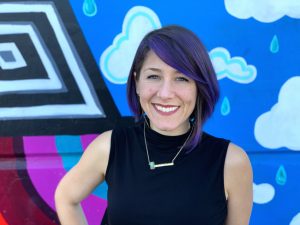 Performer’s Certificate from the Eastman School of Music. Dr. Venet’s research focuses on percussion pedagogy at the collegiate level, classical improvisation, and historically informed performance practice for marimba as it pertains to J.S. Bach compositions. She has presented her lecture recital entitled: Affekt and Execution: Historical Performance Practice and Contemporary Techniques for performing Bach on Marimba across the country, and her arrangement of J.S. Bach’s solo suite BWV1011/995 is published by KPP. Dr. Venet has several articles published by Percussive Notes, and Rhythm!Scene magazines; and has presented at the Florida and Virginia Music Educators Association conventions, The College Music Society National Conference, the International Trombone Festival, and was invited to co-present at the World Symposium of Choral Music in Auckland, NZ in 2020 with Dr. Cara Tasher.
Much of Dr. Venet’s work as a chamber musician is as a member of the percussion duo Escape Ten with Annie Stevens. Together they have performed as guest artists and clinicians nationally and internationally at such venues as: the Ágora Actual Percussion and WASBE 2019 festivals in Spain, the Academy of the Performing Arts (UTT) in Trinidad, at the Barnes Foundation in Philadelphia, The Eastman Summer Percussion Festival, and at the Leigh Howard Stevens Marimba Seminar. They are the recipients of a marimba duo commission awarded from the prestigious Fromm Foundation entitled, Illuminations (2018), and was premiered at the Cummer Museum in Jacksonville, Florida. In 2016 they performed three world premieres as a Showcase Concert at the Percussive Arts Society International Convention; and have collaborated with such composers as: Michael Burritt, Russell Hartenberger, Warren Wolf, Aurél Hollo, Emmanuel Séjourné, Ivan Trevino, Joe Locke, Chad “Sir Wick” Hughes, Steve Danyew, Steve Ridley, Drew Worden, and Kelly Rossum. Moreover, Escape Ten are signature artists with Malletech & Keyboard Percussion Publications, and have recorded two CDs: Colours of a Groove (Escape Ten Records, 2014), and Our Favorite Things (Ravello Records, 2020).
Dr. Venet’s compositions are published by DrGlockenAV Publications, Keyboard Percussion Publications (KPP), Tapspace, and Alfonse-Production. She has composed for the Grammy winning ensemble Third Coast Percussion, and has two new works for chamber percussion that are to be premiered at the 2021 Percussive Arts Society International Convention. Along with being an artist for Malletech, Black Swamp Percussion, DREAM Cymbals, and Remo Drumheads, she currently, serves on the Board of Directors for the Green Vibes Project, and is an active member of the Percussive Arts Society, and the Florida Music Educators Association.
When did you begin studying music?
I began studying music in the fourth grade. My first instrument was violin, so I joined the orchestra in my elementary school. I then began piano lessons in the sixth grade. In high school I got recruited into the marching band to play in the front ensemble (xylophone). I then did both band and orchestra all the way through high school and my first year of college.
What made you choose percussion?
Ultimately, after playing multiple instruments for several years, I chose to pursue a serious career path in percussion because I felt it was something that let me stand out as an individual. Ultimately, I felt more successful and autonomous as a soloist and musician in the percussion realm, and it provided lots of opportunities to be creative and interact with others in fun and collaborative ways.
Who were your primary teachers?
My middle school orchestra director was Frieda Denson: she was an amazing and dedicated teacher, and my earliest meaningful memories from my public school music education come from her. My high school teachers are the reason why I ultimately chose to do percussion/music professionally. They were my band director, Bob Edgar, who always encouraged me in all the things that I was interested in and my percussion teachers, Elizabeth Bayersdorffer-Meltzer, Stephen Ridley, and Casey Farina, who are the reason why I fell in love with marimba. I never took private lessons until college, and they took me under their wing and gave me so much of their attention, time, and energy. I then did drum and bugle corps with the Santa Clara Vanguard, and my front ensemble instructor, Jim Ancona, was a huge part of my musical upbringing as well. Elizabeth, Stephen, and Jim, were all huge marimba geeks and gave me an extremely solid foundation. My college teachers were also amazing and I was so lucky to study with them! At Arizona State my main professor was Dr. J.B. Smith. At Rutgers for my Master’s degree, my teachers were She-e Wu and Bob Becker. And at Eastman for my DMA, I studied with Michael Burritt, Bill Cahn, Charles Ross, Leigh Howard Stevens, and Lee Vinson.
When did you decide to pursue a career in music and did you have a specific goal?
It was in high school. My current goals include performing, teaching, and composing as a regular part of my career path. I am a full-time professor at a Teaching Institution. In addition to this, I maintain a steady performance schedule as a soloist and as a chamber musician with my duo, Escape Ten, nationally and internationally. More recently, I have kept very busy with a lot of composing – doing commissions and things for my own programs and for my students. Each thing is incredibly important, yet gives me a uniquely different satisfaction in the best way possible.
Do you focus on a specific area of percussion, if so, did you always?
The world of percussion is very large, and I think most of us start with something more specific. For me, it was keyboard percussion via marching band when I was in high school. Because I had a piano and violin background I was recruited for the band. As I progressed through my college career as a student, I was surrounded by different influences that included peers, teachers, genres, and instruments. So, I became more interested in what I experienced, and sought out to learn about things that were less familiar to me. I would say the marimba is my first love. I would identify as a classical/contemporary percussionist, which includes a lot of things. Throughout my career I became very interested in Baroque performance practice for Bach on Marimba, Pedagogy, Improvisation, and Chamber Music which are my areas of professional research and creative activity.
Who impacted your musical growth the most?
I think I’d have to go with my first percussion teachers, Liz Bayersdorffer and Stephen Ridley, and my last collegiate teacher, Michael Burritt. My first teachers had a sincere passion for marimba within many facets beyond the marching percussion realm. Although I never took private lessons officially in my high school years, they got me hooked and introduced me to what that world was, and what could be ahead of me. I think Michael Burritt really pushed me to think outside of the box and be thoughtful and intentional. I have become much more cognisant of what I’m trying to say musically, and of the big picture overall. He also provided the model example of what I wanted my own collegiate percussion studio and program to look like.
What teaching positions have you held?
Currently I am an Associate Professor and head of the percussion department at the University of North Florida. Prior to this I was a DMA student at Eastman where I taught the percussion methods class to undergrad Music Education majors, and taught lessons to non-music majors from the University of Rochester. I taught a sabbatical replacement at Oklahoma City University while at Eastman, which was my first official college teaching gig outside of being a graduate student. Before going back to school to get my doctorate, for 11 years I taught private lessons, percussion ensemble, and marching band to high school and middle school students; in addition I taught drum corps for four years. Most notably during this time, I taught at Marcus High School under Kennan Wylie in Flower Mound, TX.
What percussionists have inspired you the most and why?
I have to think about the people that are doing what I admire most and aspire to be: Michael Burritt is an incredible and enthusiastic performer, composer, teacher, and person. He is the epitome of what I want to be when I grow up. Prior to being his student, every interaction I had with his students at competitions and events abroad was positive and was something that I knew I wanted to be a part of. She-e Wu is an amazing musician and someone I look up to immensely, especially in my younger years as a big marimba geek. Leigh Howard Stevens changed the game for marimba and is such a creative, focused spirit. I’ve had the pleasure to develop a personal relationship with him as well and I respect him immensely. I also think that Valerie Naranjo is AMAZING. After working with her as a guest artist at UNF, I gained such a huge respect for what she represents for women in percussion.
Is there a specific genre you enjoy performing the most?
I really like contemporary solo music, Bach on marimba, and small chamber music. Right now, I really like playing my own compositions on any instrument.
What composers do you identify with and why?
I love the music of Iannis Xenakis and Alejandro Viñao. The rhythmic complexity, intrigue, and groove really gets my blood pumping! I am a sucker for rhythm – so music that keeps me interested with its feel, yet makes me smile because of its harmony, really hits home. When I compose, those are elements I strive to fulfill. I also really enjoy Michael Burritt’s music, especially his harmonic voice, and Joe Locke’s lyricism. Does Radiohead count? Because they are my most favorite band and creators of music of ALL TIME!
Do you get nervous before you play – if so, how do you deal with it?
Yes, Absolutely! More severe when I was young. The biggest thing that has helped me is to be focused on the right things: what you are trying to say musically, what the significance of each piece is on behalf of the composer, performer, and listener, making sure that you are as prepared as possible so that you KNOW the music, and setting up yourself to be physically and mentally prepared before and during the show. I am more careful about what I do before a concert because I have found that so much of it pertains to mental readiness. These things are in contrast with what DID NOT help my performance anxiety: focusing on not messing up, worrying about what people think of you, errors, etc. Having a really good concept of the big picture and subsequently knowing the music really well helps you see beyond small errors so that you don’t get easily derailed and distracted. Also pride is a dangerous thing. Throw that out the window!
Do you ever make a mistake while performing? If so, how do you go about resolving it?
Yes, I am human. As I mentioned before, I think being able to see and communicate the big picture of a piece allows you to focus beyond what is happening right in the moment, right in front of you, and not be completely derailed by small mistakes. In addition, if you always stop to correct mistakes in practice, instead of rehearsing recovery (sometimes playing through the rough stuff), then you will likely stop when you mess up because you’ve only heard it one way. It is also good advice to not visually react to mistakes. Many times, if you are confident and have a good sense of what you are trying to say, it can go undetected.
Has your practice regimen changed from when you were a student? And how do you keep your technique fresh on all primary percussion instruments?
Yes it has changed – I have less time to practice now than when I was a student! But practicing many many hours a day in my most formative years set me up with a good foundation as a professional. Especially when I have concerts and gigs planned, I try to schedule at least two hours of practice each day. When I make my regular teaching schedule each semester, I make sure to carve out time for practice and research. It is sacred. Based on what I am performing and teaching, I arrange my instrument practice accordingly.
How do you define a good musician and a good teacher? And has your definition of both changed from when you were a student to the present?
A good musician is someone who has a natural, mature sense of what they hear, what they want things to sound like, and are able to express those things effectively. I also think it is incredibly important that a good musician can be flexible and in the moment in a variety of performance-related situations. A good teacher also needs to be a good musician. In addition, a good teacher is someone who is enthusiastic and communicative about the content they are teaching, and is able to creatively adapt to many different types of students and their learning styles in a positive and encouraging way. Along with all of this, they must have a disciplined approach so there are structured parameters with goals for students to grow.
Do you think that performing and teaching are intrinsically intertwined? If so, how and why?
Yes! I think that there can be good performers who are not good teachers, and good teachers who may not be the best performers — but those who are really strong in both categories are the most effective and successful. I also think that being a music teacher who performs is essential; it makes your approach relatable and relevant to students. I also think that effective teachers can troubleshoot their own challenges as musicians and also can learn a TON by teaching as well. Which perpetuates constant learning.
Has teaching made you a better musician, if so how and why?
Absolutely it has! I have learned so much by breaking things down and trying to define things for students, which has resulted in having my own pedagogical epiphanies. This has allowed me to be more methodical, and thoughtful about how I learn and play music.
What inspires you to compose, and do you usually have a specific grade level in mind when you do?
My environment and nature have definitely been the biggest factors that have inspired me to write. For example, a marimba quartet I wrote called Refrakt is inspired by the behavior of light refraction when it passes through things like water or glass. My most recent commission is called CAT 5, and is based on the cycle of hurricanes and musical elements in five. My first marimba solo is called Lava, and focuses on the dark, ominous, but explosive potential of the marimba while aligning with the behaviors of molten Lava. I also get really inspired by things that make me smile because of rhythmic or harmonic content that is intriguing. I file those things away and have written pieces based on those single elements. And finally, I also have written pieces that are inspired by things that I find fun and make me happy. Examples of this would be one of my recent commissions for Third Coast Percussion, Bulldog, which is inspired by my English bulldog Shosti, and two vibraphone + quartet pieces written in the spirit of the Mighty-Morphin Power Rangers from the 1990s.
Most often, when I am composing, I usually just write what is in my head. I think that is a good place to start, and from there I can usually find ways to make things more difficult or a bit more simplified to achieve pedagogical goals while still respecting the musical intent. With situations where there are very specific parameters, like a commission for a high school or things that I intend my students to play, I really try to accommodate the needs of the group while keeping the content something they can dig into musically.
How do you feel when someone performs your work differently than you intended?
I think seeing others perform my music really helps me to find the best ways to communicate what I want on paper. Things that may seem obvious to someone are not always obvious through the medium of notation. In this way, I have become a better engraver! Alternately, I also try not to micromanage the score so that there can be different interpretations. With that said, I think different interpretations are good, as long as the performer is playing the notes and rhythms accurately as the foundation.
What would you like others to know about your compositions?
I like to write things that make me smile, and things that I would want to play. I would also say that I think because my tunes are often harmonically or rhythmically pleasing, sometimes the difficulty level can be a bit deceiving. If it’s pretty, it doesn’t mean it’s easy! I love complicated rhythms and try to find ways to explore that concept within harmonic parameters that bring me joy.
Knowing what you know today, would you change anything about how you prepared for your career? If so, what and why?
I think by the time I got to working on my DMA, I recognized many things that I wish I would have done earlier or wanted to know more about. Therefore, I really did not take that last chance to go to school for granted. If I could change anything, I would have been more open to explore more instruments and types of music outside of my comfort zone when I was younger, and not to have been so worried about comparing myself to others around me. How I run my studio, and the interaction I have with my students is highly informed by the things that I wish I would have known or wish I would have done. I also would have done more summer festivals and started composing earlier!
What words of wisdom would you share with a student who aspires to make a career as a performer and as an educator?
For someone that wants to be a performer and an educator, you must be skilled as a player AND have a personality conducive to working with people. Both of these elements need to be driven by passion and enthusiasm; both should be interchangeably contagious.
If you would like to learn more about Dr. Venet, please visit her website at: www.AndreaVenet.com